Air Filter Classes for General Ventilation
Selecting the correct air filters is an important part of designing effective ventilation systems. Filters help remove airborne particles, protect ventilation equipment and support good indoor air quality. However, filter selection must also consider energy consumption, maintenance requirements and the intended use of a building.
At Varming Consulting Engineers, we recognise the importance of balancing filtration performance with energy efficiency when designing mechanical building services.
Understanding Air Filter Classifications
Air filters are classified according to their ability to remove airborne particles. The EN ISO 16890 standard provides a method for assessing filters used in general ventilation systems, replacing the older EN 779 classifications.
Rather than relying on the previous G and F filter classes, EN ISO 16890 evaluates filtration performance against different sizes of particulate matter (PM). This provides a clearer understanding of how filters perform against particles commonly found in outdoor air.
Air Filter Classes Explained
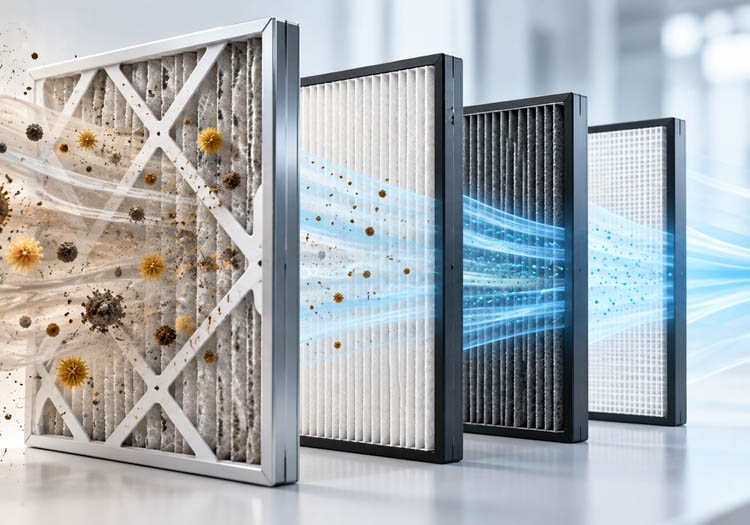
The standard identifies four main filter groups:
- ISO Coarse: Designed to capture larger particles, including dust and debris. These filters are commonly used as pre-filters to protect downstream filtration stages and ventilation equipment.
- ISO ePM10: Assesses filtration efficiency for particles up to 10 micrometres in diameter, including larger airborne dust particles.
- ISO ePM2.5: Measures efficiency against finer particulate matter, which can penetrate deeper into the respiratory system.
- ISO ePM1: Evaluates filtration performance against very fine particles up to 1 micrometre in diameter, supporting applications where higher levels of particulate filtration are required.
Each ePM classification includes a percentage indicating the filter’s measured efficiency against the relevant particle fraction.
Selecting the Right Air Filter
Choosing suitable air filter classes for general ventilation requires consideration of several factors. These include outdoor air quality, building occupancy, required indoor air quality and the characteristics of the ventilation system.
For example, offices, educational facilities and healthcare buildings may have different filtration requirements depending on their activities and environmental conditions.
Filter selection should therefore reflect the specific building application rather than adopting a single approach for every ventilation system.
Balancing Indoor Air Quality and Energy Efficiency
Filtration performance is closely linked to ventilation system design. As air passes through a filter, resistance to airflow creates a pressure drop that must be overcome by the system’s fans.
Higher filtration efficiency does not automatically mean greater energy consumption. Filter design, pressure drop, dust-loading characteristics and maintenance all influence overall performance.
Selecting filters with suitable efficiency and pressure-drop characteristics can help maintain indoor air quality while managing fan energy consumption. Regular inspection and timely replacement are also important for maintaining reliable operation.
Supporting Effective Ventilation Design
Appropriate air filtration contributes to healthier indoor environments, protects mechanical equipment and supports efficient ventilation system operation.
At Varming Consulting Engineers, our mechanical engineering team considers filtration requirements alongside airflow, energy performance and building-specific needs to develop integrated ventilation solutions.
Planning a project with ventilation requirements? Explore our Mechanical Engineering Services or contact Varming Consulting Engineers to discuss how we can support your building design.