Nature-Based Solutions in Urban and Building Design
Nature-Based Solutions in Urban and Building Design play an increasingly important role in how M&E consulting engineers and building services design consultants respond to climate pressures. Over the past decade, Nature-Based Solutions (NBS) have become embedded within sustainable development strategies, sitting alongside low-energy building services and high-performance building fabric as recognised tools for climate-responsive design. International policy frameworks and local authorities now promote NBS as part of an integrated response to climate mitigation and adaptation.
At an urban scale, blue-green infrastructure, floodable landscapes and coastal systems work with natural processes to deliver measurable environmental benefits. These approaches reduce flood risk, moderate urban temperatures and enhance ecosystem services. Unlike purely engineered defences, they support long-term climate resilience. As a result, designers now regard NBS as a practical component of contemporary city planning.
What Are Nature-Based Solutions?
Nature-Based Solutions use natural systems, or processes inspired by nature, to address environmental, social and economic challenges. In cities and buildings, designers typically apply NBS to manage heat stress, improve air quality and control surface water runoff. These measures also contribute to occupant wellbeing.
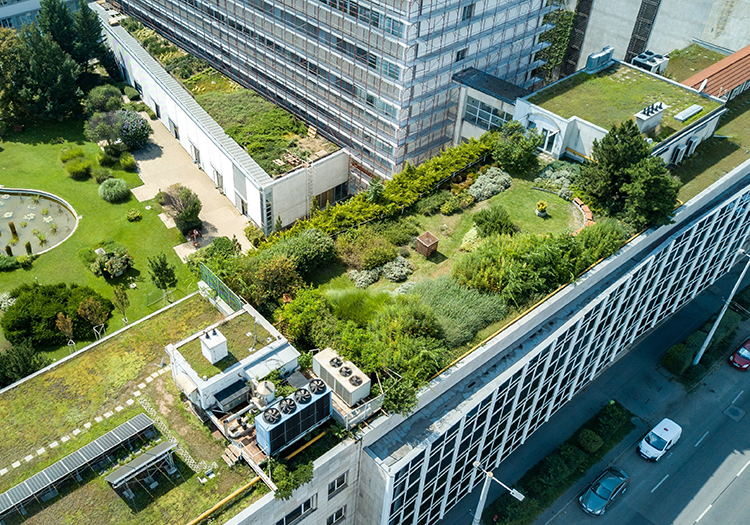
Common examples include green roofs, living walls, urban tree planting and permeable surfaces. Sustainable drainage systems (SuDS) slow and attenuate rainfall runoff. Together, these measures reduce the urban heat-island effect and improve local microclimates. From a building design perspective, they can also reduce cooling demand and mitigate peak stormwater flows.
In many projects, NBS involve reintroducing vegetation into heavily developed areas. This approach improves visual amenity and supports biodiversity. It also contributes to better air quality and reduced carbon concentrations in dense urban environments.
Biodiversity, Resilience and Urban Performance
Nature-Based Solutions offer the ability to deliver multiple outcomes through a single intervention. Well-designed schemes can increase biodiversity and improve resilience to climate impacts. They also enhance the quality of life for building occupants and city residents.
Professional and academic discussions have consistently highlighted the role of NBS in urban resilience and sustainable development. Industry forums, including the ARCC Conference, have emphasised the need to integrate natural systems with traditional engineering solutions. This integration helps reduce the environmental impact of the built environment.
Declan Alcock, Director and Chartered Engineer at Varming Consulting Engineers, has contributed to this discussion through ongoing professional engagement. He has consistently highlighted the value of embedding NBS alongside efficient mechanical and electrical systems. This approach supports resilient, low-impact building design.
Nature-Based Solutions in Climate-Responsive Design
Nature-Based Solutions do not replace efficient M&E systems or high-performance building envelopes. Instead, they complement an integrated design approach that supports Net Zero ambitions and climate adaptation. When engineers coordinate NBS with energy-efficient plant, smart controls and robust building fabric, buildings achieve stronger overall environmental performance.
At Varming Consulting Engineers, we support the considered use of Nature-Based Solutions as part of holistic, performance-led building services design. By aligning engineering expertise with natural processes, cities and buildings become more resilient and healthier for occupants. This approach also helps developments respond effectively to ongoing climate challenges.
In this context, Nature-Based Solutions in Urban and Building Design form an important part of integrated, performance-led engineering strategies.
To view examples of our work or to learn more about our approach to sustainable building services engineering, visit www.varming.ie. If you would like to discuss your project requirements, you can contact our Dublin headquarters on 01 487 2300.